ADA Requirements for Ramps: A Complete Compliance Guide
Updated on January 12, 2026
Why ADA Ramp Requirements Matter
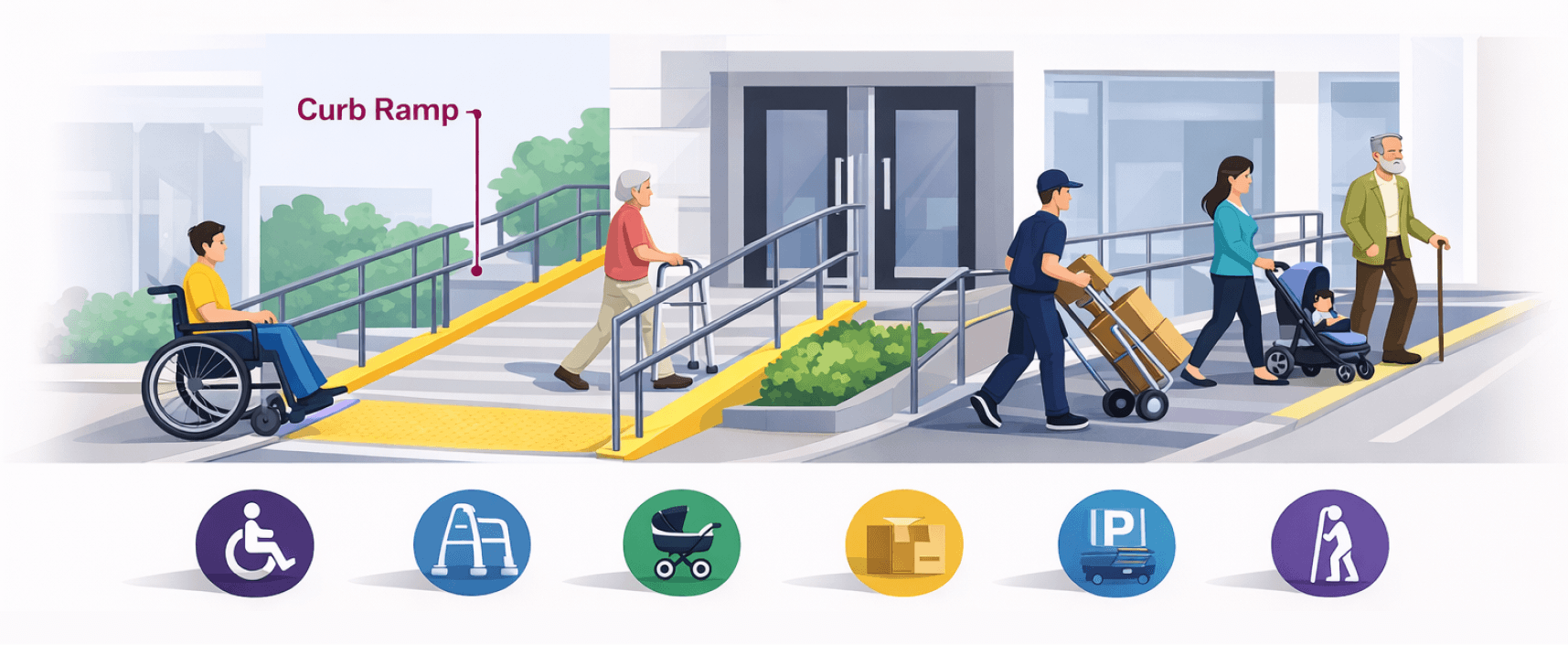
Ramps make buildings usable for people who can't rely on stairs. For many users, steps are a barrier, not an option.
ADA-compliant ramps support wheelchair users, people using walkers, and anyone with limited mobility. They also help parents with strollers, delivery staff, and older adults. In real life, ramps benefit more people than most businesses realize.
Not every slope counts as a ramp. The ADA has clear rules to prevent ramps from being too steep, too narrow, or unsafe to use independently.
There's also a difference between ramps and curb ramps. Regular ramps connect entrances and levels. Curb ramps connect sidewalks to streets at crossings. Both must follow ADA standards.
This guide explains those requirements in plain terms, so you can understand what's required and why it matters.
What Counts as a Ramp Under the ADA
Under the ADA, a ramp has a very specific definition. It's not just any sloped surface. A ramp is a walking surface with a slope steeper than 1:20.
If the slope is 1:20 or gentler, it's considered a walkway, not a ramp. Once it's steeper than that, ADA ramp requirements apply.
The purpose of a ramp is simple: to provide an accessible alternative to stairs. It allows people using wheelchairs, walkers, or other mobility aids to move between levels safely and independently.
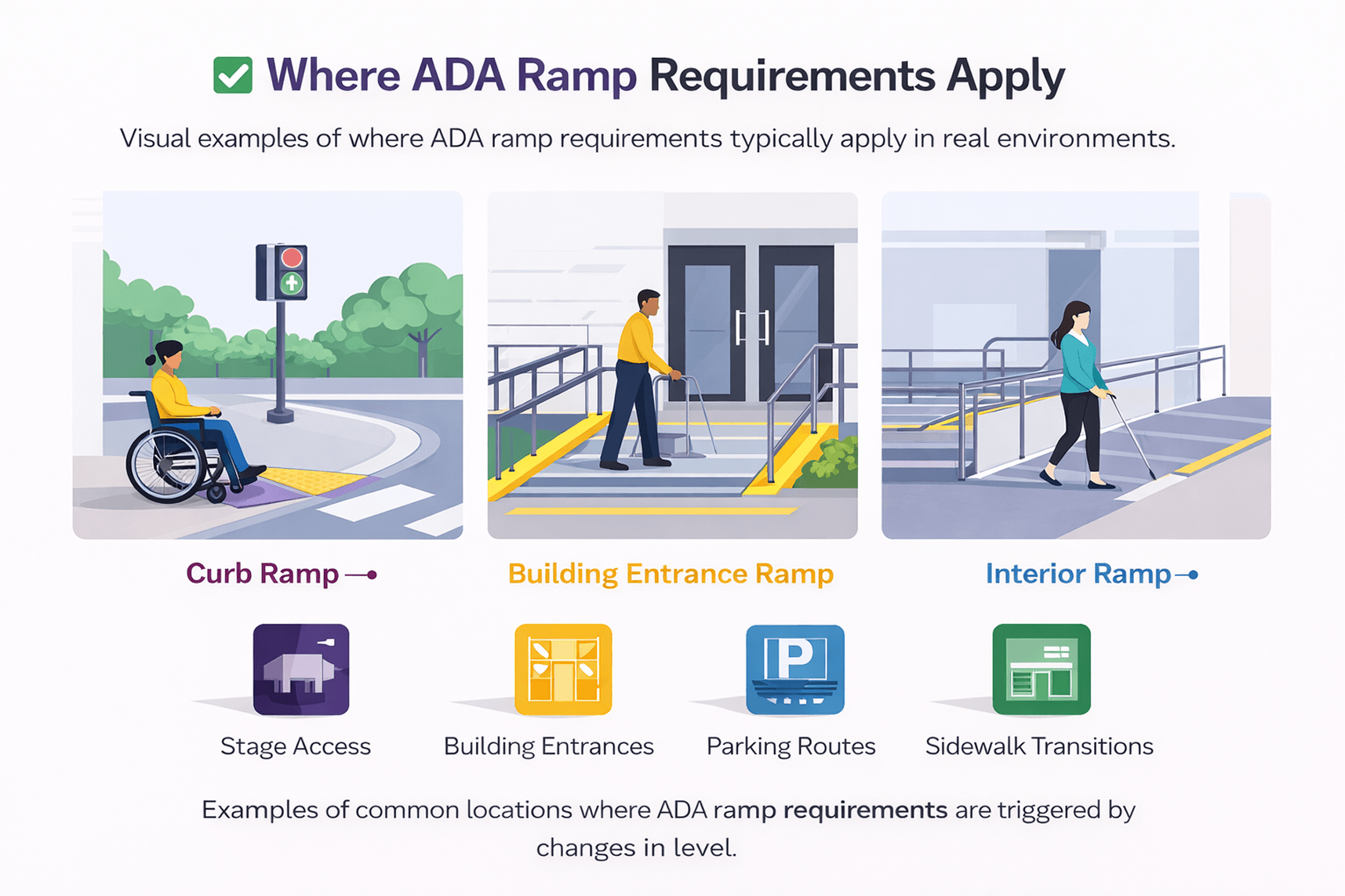
Ramps are required anywhere an accessible route needs to cross a change in height. This includes building entrances, interior level changes, stage access, parking routes, and sidewalk transitions.
Curb ramps are a common example. They connect sidewalks to streets at crosswalks. Interior ramps are another, often used when a building has split levels or raised entrances.
If there's a height difference and stairs are present, the ADA generally expects a compliant ramp to be provided as well.
Free Web Accessibility Checker
Enter your website URL to get a free, instant accessibility scan with tabnav's checker.

Overview of ADA Requirements for Ramps
ADA ramp requirements are designed to make sure ramps are safe, usable, and consistent across different buildings and environments. The goal isn't just access, but access that people can use comfortably and without risk.
At a high level, ADA standards cover things like width, slope, surface conditions, landings, handrails, and edge protection. Each of these plays a role in how easy or difficult a ramp is to use in real life.
The ADA also sets limits on how steep a ramp can be, how much vertical rise is allowed before a landing is required, and how ramps should handle turns or direction changes. These rules help prevent ramps from becoming exhausting, unsafe, or unusable.
In the sections below, we break each requirement down clearly and practically. No legal language, just what you need to know to understand whether a ramp meets ADA standards and where issues commonly occur.
All requirements referenced are based on the federal ADA Accessibility Guidelines, which are used nationwide for public and commercial spaces.
Minimum Ramp Width Requirements
The ADA requires ramps to have a minimum clear width of 36 inches. This measurement is taken between handrails, if handrails are present, or between any other obstructions along the ramp.
Handrails matter here. If a ramp includes handrails on one or both sides, they cannot reduce the clear width below 36 inches. The usable space must remain clear for wheelchair users the entire length of the ramp.
In practice, wider ramps are often needed. Ramps in busy areas, public buildings, or locations with frequent use may require extra width to allow smoother movement and easier passing.
Two-way traffic is another factor. While the ADA sets a minimum, it doesn't prevent designers from going wider. If people are expected to travel up and down the ramp at the same time, additional width improves safety and usability.
It's also important to check local building codes. Some jurisdictions require ramp widths that exceed ADA minimums. When that happens, the stricter requirement applies.
ADA Ramp Slope Requirements
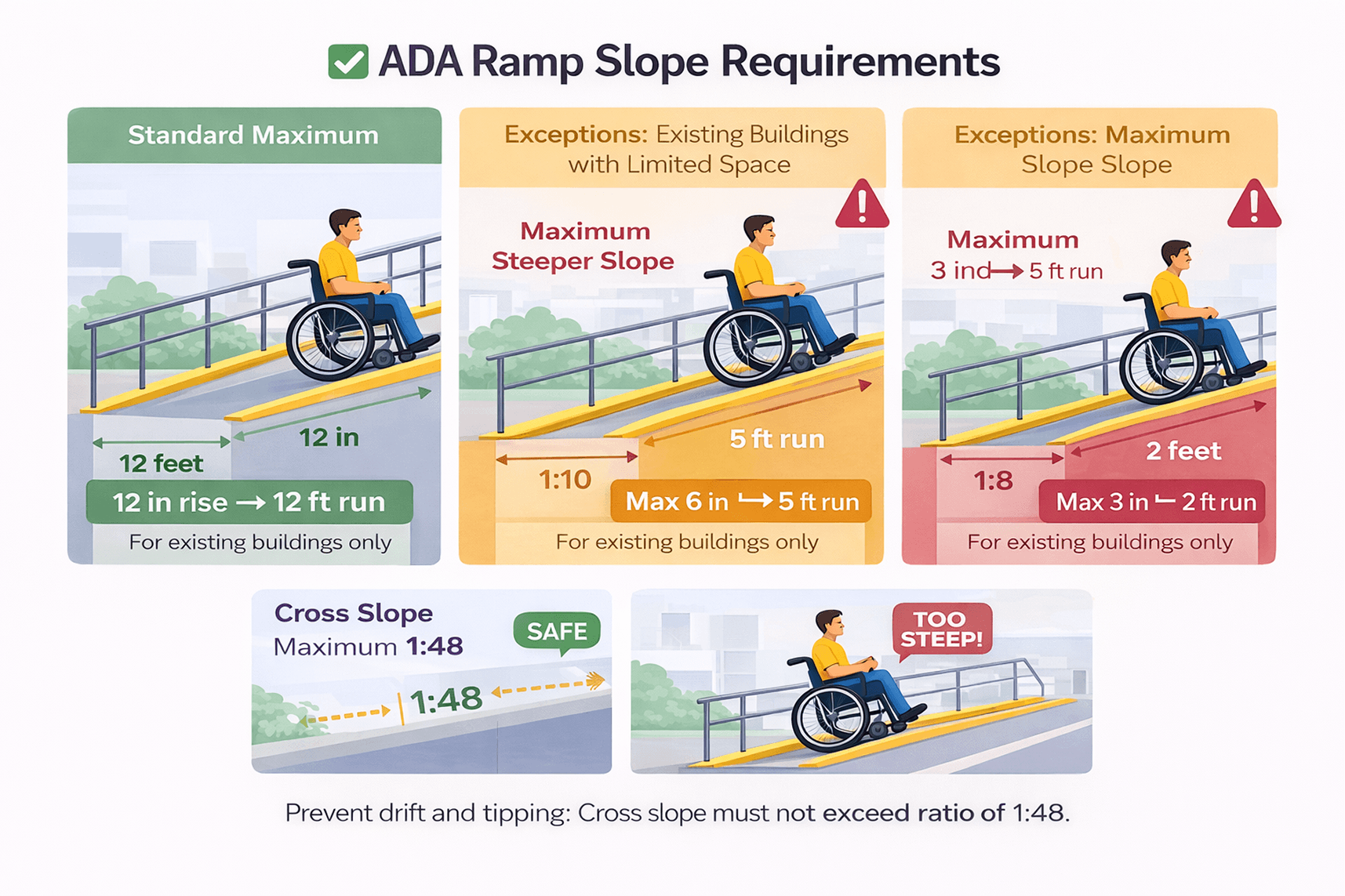
The ADA sets a maximum ramp slope of 1:12. This means that for every inch of vertical rise, the ramp must be at least 12 inches long. For example, a 12-inch rise requires a ramp that's at least 12 feet long.
This ratio is critical for usability. Slopes steeper than 1:12 can be difficult or unsafe for wheelchair users and exhausting for people pushing mobility aids or strollers.
There are limited exceptions for existing buildings where space is restricted. In those cases, the ADA allows slightly steeper slopes:
- Up to 1:10 for rises of 6 inches or less
- Up to 1:8 for rises of 3 inches or less
These exceptions are not intended for new construction and should be used only when standard compliance isn't structurally possible.
The ADA also regulates cross slope, which is the slope across the width of the ramp. Cross slope must not exceed 1:48. This prevents wheelchairs from tipping or drifting sideways.
Slope matters because it directly affects safety, control, and fatigue. Even small deviations can make a ramp far harder to use in real-world conditions.
Ramp Rise Limits and Segment Rules
The ADA limits how much height a single ramp run can cover. No ramp run may rise more than 30 inches before a landing is required.
Once a ramp reaches that 30-inch rise, a level landing must be provided before the ramp can continue. This gives users a place to rest, stop, or change direction safely.
There is no maximum overall height a ramp can reach, as long as it's broken into proper segments with landings in between. Long ramps are allowed, but they must be designed in manageable sections.
These rules exist for a reason. Long, uninterrupted ramp runs increase fatigue and reduce control, especially for wheelchair users and people moving uphill. Segmenting ramps with landings improves safety and makes ramps usable in real-world conditions.
Ramp Surface Requirements
ADA-compliant ramps must have firm, stable, and slip-resistant surfaces. This helps prevent falls and allows mobility devices to move smoothly without losing traction.
Surface regularity matters just as much as material. Ramp surfaces should be even and free of sudden changes in level. Cracks, gaps, or uneven joints can cause wheels to catch or create tripping hazards.
Any vertical changes along the ramp should be minimized. Small height differences may be allowed in limited cases, but anything noticeable can make a ramp unsafe or unusable.
Common suitable materials include textured concrete, treated metal, non-slip composites, and other surfaces designed to maintain traction in both dry and wet conditions. Whatever material is used, it must stay slip-resistant over time with proper maintenance.
Edge Protection Requirements
Edge protection is required on ADA ramps when there is a risk of wheels slipping off the side. This typically applies when there's a vertical drop-off along the ramp edge.
The ADA allows a few types of edge protection. The most common option is a curb or curb rail that's at least 2 inches high and runs along the ramp edge. This helps keep wheelchairs and mobility aids safely on the ramp.
Another option is an extended ramp surface. In this case, the ramp surface continues at least 12 inches beyond the inside face of the handrail, providing enough space to prevent wheels from slipping off.
Edge protection is required when there is a vertical drop of more than 1/2 inch along the side of the ramp. If the drop is smaller, edge protection may not be necessary.
When handrails are installed, edge protection is often integrated into the design. A lower rail or curb beneath the handrail can serve both safety and accessibility needs without adding extra elements.
Landing Requirements for ADA Ramps
ADA ramps must include level landings to give users safe places to stop, rest, or change direction.
Each landing must be at least as wide as the ramp and a minimum of 60 inches long in the direction of travel. This provides enough space for a wheelchair to fully rest on the landing.
Landings are required at the top and bottom of every ramp run, and at any point where the ramp changes direction. Long ramps also require intermediate landings when the maximum rise is reached.
Landings must be level. The slope of a landing cannot exceed 1:48 in any direction, ensuring stability for users.
If a door opens onto a landing, the landing must be large enough so the door swing does not reduce the required clear space. Users must be able to open the door and maneuver safely without being pushed off the ramp.
Adequate turning space on landings is essential, especially where ramps change direction or connect to entrances.
Handrail Requirements for Ramps
Handrails are required on ADA ramps when a ramp has a rise greater than 6 inches or a horizontal length longer than 72 inches. In these cases, handrails must be installed on both sides of the ramp.
The required handrail height is 34 to 38 inches above the ramp surface. This range ensures the handrails are usable for people with different heights and mobility needs.
Handrails must be continuous along the full length of the ramp run. They should not be interrupted by posts or other elements that break the gripping surface. At the top and bottom of the ramp, handrails must extend 12 inches horizontally, unless doing so would create a safety hazard.
Grip size and shape matter. Round handrails should have an outside diameter between 1.25 and 2 inches. If the handrail is not round, the perimeter must be easy to grasp, with no sharp edges or complex shapes.
There must be at least 1.5 inches of clearance between the handrail and any wall or surface. This prevents hands from getting trapped and allows a full grip.
Finally, handrails must be strong and stable. They need to support users who rely on them for balance, weight-bearing, or safe movement along the ramp.
ADA Ramp Requirements for Alterations and Existing Buildings
ADA rules are stricter for new construction and more flexible for existing buildings. When a ramp is part of new construction, it must fully meet current ADA standards.
For alterations to existing buildings, the ADA uses a "maximum extent feasible" rule. This means the ramp should meet ADA requirements as closely as possible, unless structural conditions make full compliance impractical.
In some alteration scenarios, steeper slopes are allowed when space is limited:
- Up to 1:10 for rises of 6 inches or less
- Up to 1:8 for rises of 3 inches or less
These exceptions apply only when a compliant 1:12 slope cannot be achieved.
Level changes must also be controlled. Vertical changes along ramps or landings should be minimized. Any change over 1/4 inch becomes a potential barrier and must be properly treated to avoid tripping or mobility issues.
A common example is retrofitting an older entrance where walls or foundations can't be moved. In these cases, the ramp design must balance accessibility with existing structural limits while still providing safe, usable access.
Wet Conditions, Drainage, and Maintenance
Ramps must stay safe even when wet. Rain, cleaning, or humidity should not turn an accessible ramp into a slipping hazard. That's why the ADA requires ramp surfaces to be slip resistant, not just when dry, but in real outdoor conditions.
Drainage matters. Water should never pool on a ramp or landing. Standing water increases the risk of slips and makes ramps harder to use for wheelchairs, walkers, and canes. Proper slope, surface materials, and drainage channels help prevent this.
Maintenance is just as important as design. Dirt, leaves, algae, or ice can quickly make a compliant ramp unsafe. Property owners are responsible for regular cleaning and upkeep to keep surfaces usable year round.
Outdoor landings need the same attention. They must stay level, slip resistant, and free of water buildup. If a landing becomes slick or uneven, the ramp stops being accessible, even if everything else meets ADA requirements.
Free Web Accessibility Checker
Enter your website URL to get a free, instant accessibility scan with tabnav's checker.
Common ADA Ramp Compliance Mistakes
Many ramp issues happen not because people ignore the ADA, but because small details are misunderstood or overlooked. These mistakes often look minor but can make a ramp noncompliant or unsafe.
Slopes that look compliant but aren't
A ramp may appear gentle, but even a small deviation can exceed the 1:12 maximum slope. This often happens when ramps are built without proper measurements or when ground settles over time.
Missing or undersized landings
Landings are sometimes skipped or made too small, especially at the top of a ramp or at turns. Without proper landings, wheelchair users may not have enough space to stop, rest, or change direction safely.
Improper handrails
Handrails are frequently installed at the wrong height, stop too early, or lack proper extensions. In some cases, they reduce the clear width of the ramp instead of supporting safe use.
Poor drainage
Ramps that collect water can quickly become hazardous. Inadequate drainage or clogged systems often lead to pooling water on both ramp runs and landings.
Conflicts with local building codes
Local codes may add requirements beyond ADA standards. Failing to check local regulations can result in ramps that technically meet ADA rules but still fail inspections or approvals.
Final Thoughts on ADA Requirements for Ramps
Meeting ADA ramp requirements is not only about avoiding legal issues. At its core, compliance is about making sure people can enter, move through, and use a space safely and independently.
Well designed ramps improve usability for everyone. Wheelchair users, people with walkers, parents with strollers, delivery staff, and older adults all benefit from ramps that are built with the right slope, width, surfaces, and landings.
There is also long term value in getting it right from the start. Proper ramp design reduces maintenance issues, lowers the risk of accidents, and prevents costly retrofits later on. A compliant ramp tends to age better because it was built with safety and durability in mind.
If your building already has ramps, it is worth taking the time to review them. Small adjustments can often make a big difference in accessibility, safety, and overall user experience.

You might also like...